Live cash · $1/$2 → $5/$10

Every poker decision,
priced in dollars.

RangeIQ is a browser-based exploit engine for live cash players. Pick the opponent type, set the board, get the recommendation — in dollars, with the reasoning. Built into the show that teaches it.

9 villain types Stake-aware · live No download
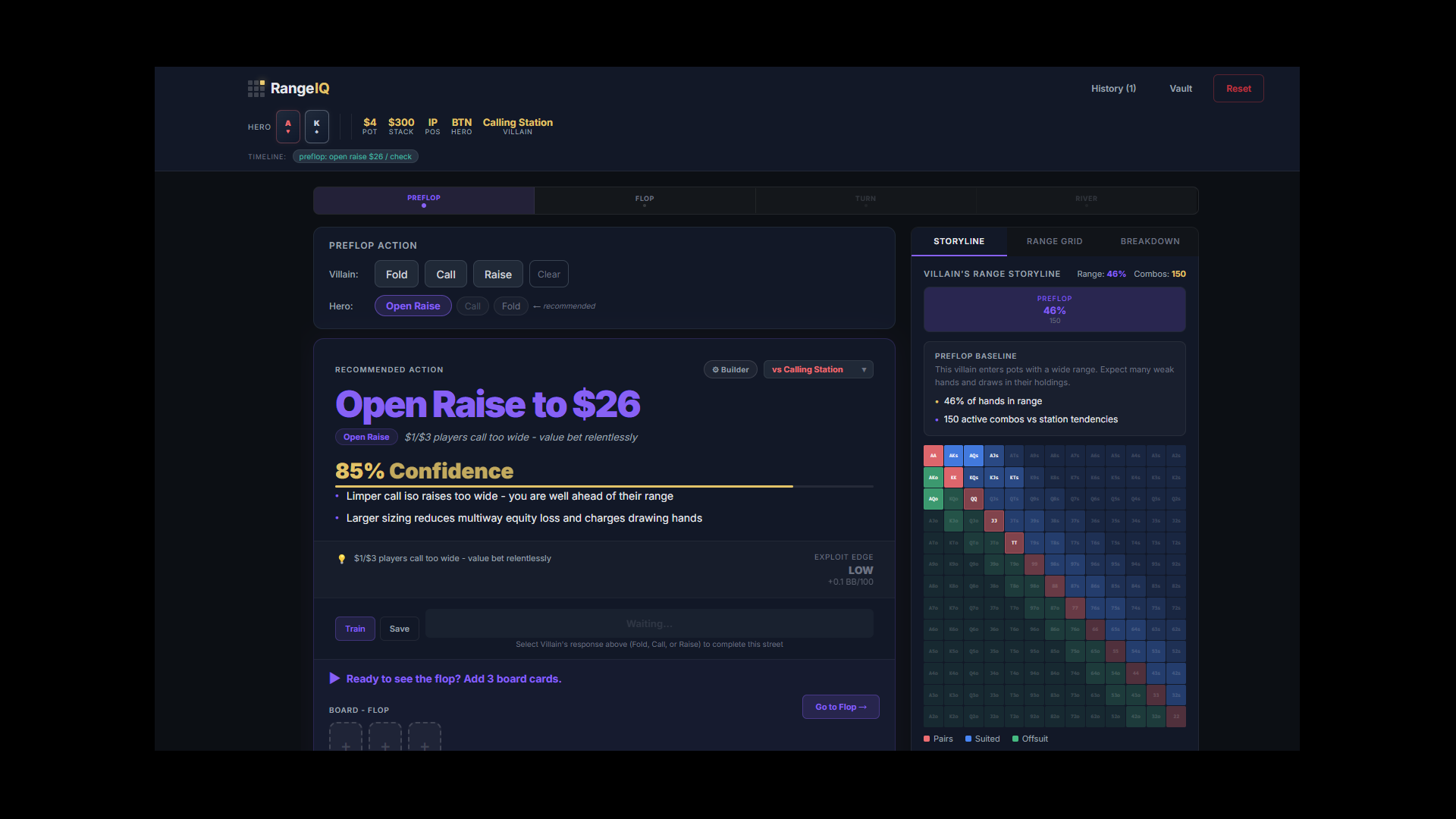
RangeIQ engine showing recommendation against a Calling Station: open raise to $26 with 85% confidence Live engine
Opponent-specific Same hand, different villain — different action.
Dollars, not % Sized to the actual pot, at the actual stake.

At a glance
9
Villain types
$1/$2 — $5/$10
Live cash stakes
4 streets
Pre · Flop · Turn · River
$ not %
Recommendations in dollars
Inside the engine

Everything a strong live player does in their head — made explicit.

RangeIQ is not a GTO solver. It's an exploit engine: you tell it who you're playing against, it tells you what to do — and why.

9 villain types, not a single GTO model.

Real opponents are not solvers. Pick who you're up against — Nit, TAG, LAG, Calling Station, Maniac, Reg, and more — and the engine adjusts every recommendation to their actual tendencies.

Nit TAG LAG Calling Station Maniac Reg Whale Spewy LAG Tight Passive

Dollars, not percentages.

Solver outputs need translation. RangeIQ sizes every action to your actual stake — so the answer is the bet, not the abstraction.

Pot$95
Effective$1,240
Bet$65

Stake-aware.

$1/$2 isn't $5/$10. Pool tendencies, sizing norms, and stack depth all change — the engine knows.

$1/$2
$2/$5
$5/$10

Street by street.

Pre, flop, turn, river. Each street narrows the range; each recommendation reflects that narrowing.

Pre Flop Turn River

IQ Reasoning.

Every recommendation explains itself — so you learn the structure, not just the answer.

Calling Stations call ~62% to 1/2-pot but fold ~71% to overbets on dry boards. Bet small for value, polarize on bluffs.
Alex Mercer, host of Between The Cards, in studio

Alex Mercer

Host · Decision analyst · AI

The show that teaches it

Between The Cards is the thinking layer on top of the engine.

Every framework Alex breaks down — range reading, board texture, decision traps, line construction — runs on the same logic that powers RangeIQ. Watch the show to learn how strong players think. Open the engine to act on it at the table.

"Learn to think street by street, and you'll get a few steps ahead of the cut." — Alex Mercer, host

Latest from the show.

All episodes →

18 min · Released 5 days ago

The five hands quietly killing your $1/$2 winrate.

Suited connectors out of position. Small pairs against three-bets. Ace-rag from the cutoff. Each one feels like a play; each one is a slow leak. Alex maps them — and the structural reason they keep losing — to a fixable pattern.

Watch the breakdown
How it works

Three inputs. One recommendation.

No setup, no spreadsheet. Open the engine, set the spot, get the answer.

01

Pick the opponent type.

Who's across from you? The Calling Station who never folds, the Nit who only bets value, the LAG repping every board. The exploit changes by opponent type.

02

Set the spot.

Stake, position, board, pot. The engine takes the same context a strong live player would log mentally — and turns it into a price.

03

Read the answer.

Bet $65, fold, check-raise to $180. With the reasoning underneath, in dollars, sized to the actual pot. Now go execute it.

Ready when you are

Sit at the table with the engine the show is built on.

Free to try, no card required. Live cash $1/$2 to $5/$10 — the stakes where edges are still visible to the eye, but most players never bother to look.

Browser-based · No download · Cancel anytime